

There’s one part of wearing press-on nails that nobody enjoys: taking them off.
When a corner starts lifting, it can be incredibly tempting to just peel the whole nail away and get it over with. But if the press-on is still firmly attached, forcing it off can pull away layers of your natural nail along with the adhesive.
The safer approach is simple: soften the bond first, then remove the press-on only when it starts releasing easily.
Whether you used nail glue, adhesive tabs, or a particularly stubborn adhesive, this guide walks you through the safest ways to remove press-on nails at home while keeping your natural nails looking and feeling healthy.
Quick Answer
To remove press-on nails without damaging your natural nails, don’t peel or pry them off. First, soften the adhesive with warm soapy water and oil, or use acetone when the glue is stubborn. Once the press-on begins to loosen, gently lift it with a wooden cuticle stick. If you feel resistance, stop and soak longer rather than forcing it.
The Golden Rule: Never Rip Off a Press-On Nail
Before getting into the different removal methods, remember this one rule:
If the press-on doesn’t want to come off, it’s not ready yet.
Trying to rip, snap, or pry off a firmly attached press-on can damage the surface of your natural nail.
That can leave your nails feeling rough, thin, or sensitive afterward.
A proper removal should feel more like releasing the nail than pulling it away.
You shouldn’t need to use force.
First, Check How Your Press-Ons Were Applied
The best removal method depends on what you used to attach your nails.
Adhesive tabs
Adhesive tabs are usually the easiest to remove. The bond can often be loosened by soaking your fingertips in warm, soapy water and gently working around the edges.
Nail glue
Glue-applied press-ons generally require more patience. Warm water and oil may help loosen the edges, but stubborn adhesive may require acetone.
Strong or gel-style adhesives
Some stronger adhesives can be significantly more resistant to soaking. If gentle methods aren’t working, acetone may be the more effective option.
When in doubt, start with the gentlest method and only move to acetone if necessary.
Method 1: How to Remove Press-On Nails Without Acetone
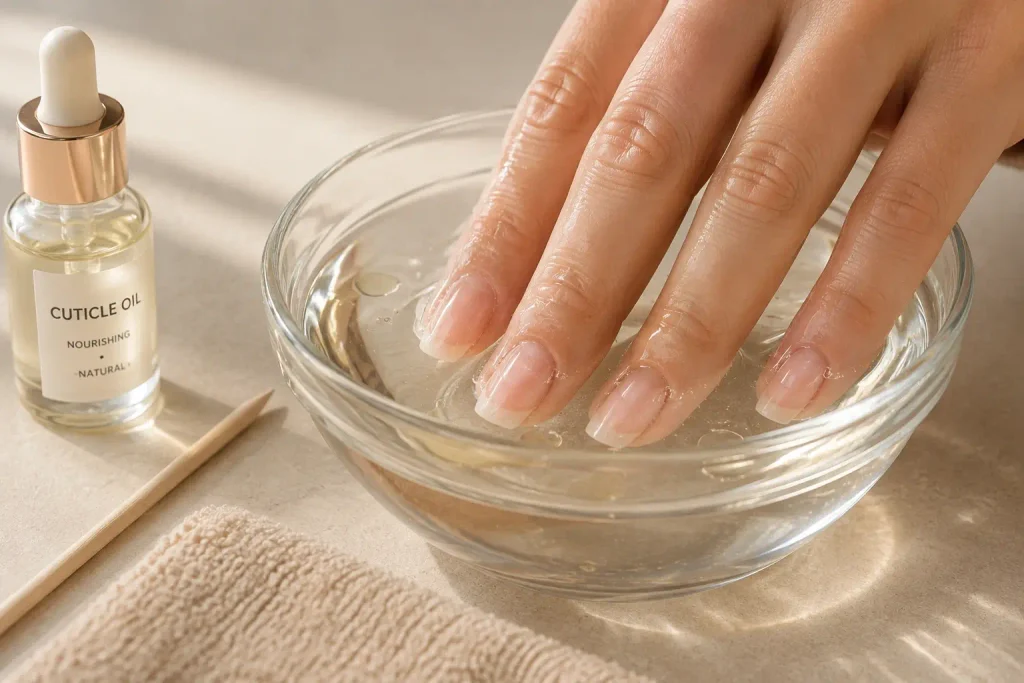
If you’re trying to avoid acetone, start here.
You’ll need:
- A bowl of warm water
- Mild hand soap
- Cuticle oil or a small amount of nail oil
- A wooden cuticle stick
- A soft nail buffer
- A clean towel
A smooth wooden cuticle stick makes a real difference here; cheap plastic ones can scratch the nail bed. I use these Orange Wood Nail Sticks; the double-sided tip works well for both pushing cuticles and gently lifting loosened edges.
Step 1: Fill a Bowl With Warm Water
Fill a small bowl with comfortably warm water.
Don’t use extremely hot water. It isn’t necessary and can irritate or burn your skin.
Add a little mild hand soap.
Then add a small amount of cuticle oil or another skin-friendly oil.
Step 2: Soak Your Fingertips
Place your fingertips in the water and allow them to soak for around 10–15 minutes.
The goal isn’t to force the press-ons off. You’re simply giving the adhesive time to loosen.
If the nails still feel completely secure after 15 minutes, keep soaking for a little longer.
Step 3: Gently Test the Edges
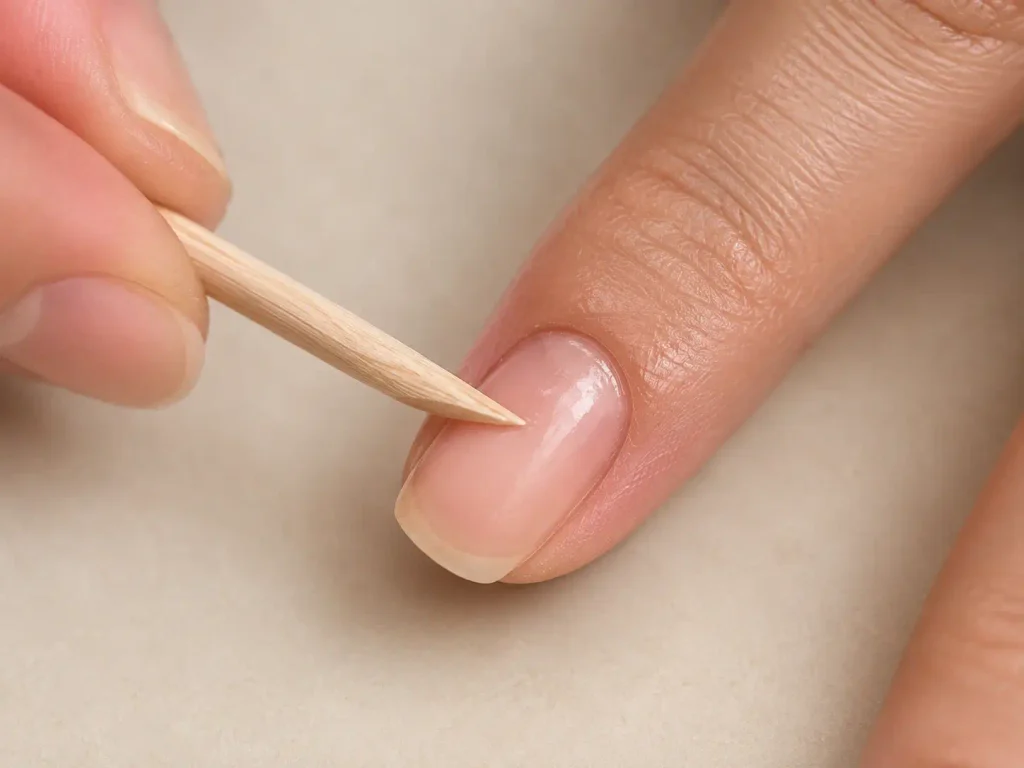
After soaking, gently move the press-on from side to side with your fingertip.
If an edge has started to release, you can carefully work around that area with a wooden cuticle stick.
Don’t push the stick aggressively underneath the nail.
Instead, use tiny movements to encourage the adhesive to release.
Important: If you feel pain, strong resistance, or pulling on your natural nail, stop. Soak again before trying another lift.
Step 4: Let the Press-On Release
Once the adhesive has loosened sufficiently, the press-on should gradually come away.
Don’t pull upward suddenly.
Work slowly from the loosened edge and allow the adhesive to release naturally.
If the nail still won’t move, don’t force it.
Simply return your fingertips to the warm water for another few minutes.
Method 2: How to Remove Press-On Nails With Acetone
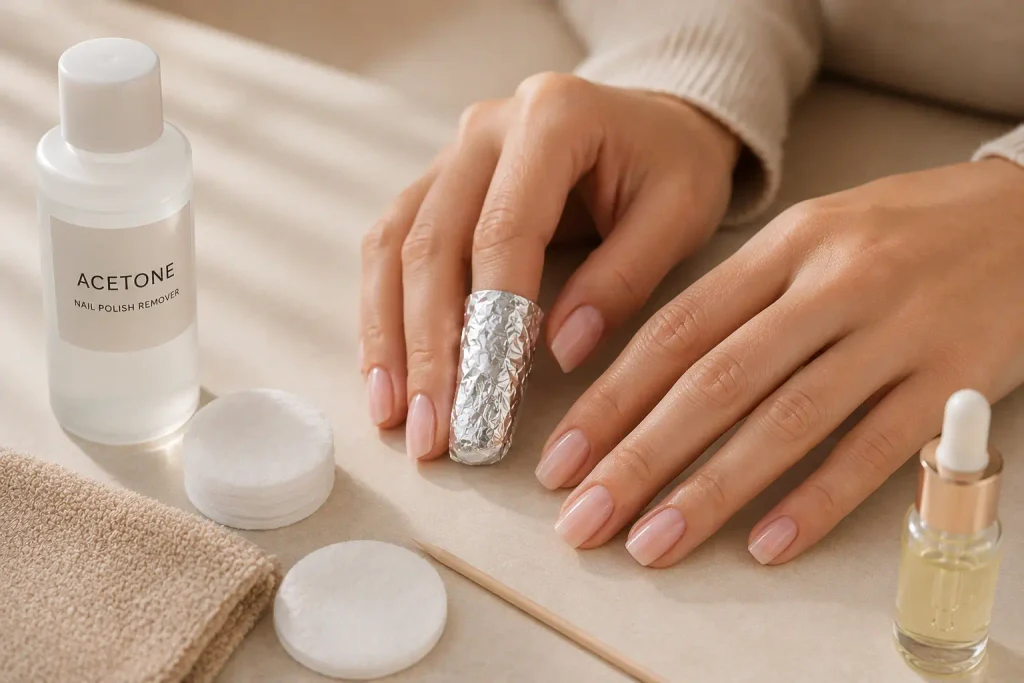
If you’ve used strong nail glue and the warm-water method isn’t working, acetone can be more effective at breaking down many cyanoacrylate-based nail adhesives.
You’ll need:
- 100% acetone
- Cotton balls or cotton pads
- Aluminum foil
- Cuticle oil or petroleum jelly
- Wooden cuticle stick
- Nail buffer
Not all acetone is equally effective; diluted “polish remover” blends take much longer to break down cured glue. I use ForPro 100% Pure Acetone, which is specifically made for stubborn glue, gel, and acrylic removal. If you’d rather skip wrapping foil around every finger, HiMo Acetone Soak-Off Clips hold the cotton in place and are reusable.
Step 1: Protect the Skin Around Your Nails
Apply a small amount of cuticle oil or petroleum jelly around the skin surrounding your nails.
Try to keep the product primarily on the surrounding skin rather than coating the nail surface.
This helps reduce the drying effect of acetone on the surrounding skin.
Step 2: Soak the Cotton
Saturate a cotton ball or cotton pad with acetone.
Place it directly over the press-on nail.
Step 3: Wrap the Nail
Wrap the fingertip securely with a small piece of aluminum foil to keep the acetone-soaked cotton in place.
Leave it for approximately 10–15 minutes, then check one nail.
The exact time can vary depending on the adhesive and how much glue was used.
Step 4: Check Before Removing
Remove the foil and gently test the press-on.
If it is still firmly attached, don’t pry it off.
Re-wrap and give it more time.
When the adhesive has softened, the press-on should begin releasing much more easily.
Step 5: Remove the Remaining Adhesive
Once the artificial nail is off, there may be some glue residue left on your natural nail.
Don’t scrape it aggressively.
Instead:
- Wipe away softened residue.
- Use a fine buffer very gently if necessary.
- Stop if the natural nail surface starts becoming thin or sensitive.
Can You Remove Press-On Nails With Oil?
Oil can help make removal more comfortable, but it isn’t a replacement for acetone when dealing with stubborn cured nail glue.
A warm soak combined with cuticle oil can help loosen the edges of some press-ons and reduce friction while you’re gently working them loose.
You can try:
Warm water + mild soap + cuticle oil → soak → gently test the edges → repeat if necessary.
For strongly bonded press-ons, however, you may eventually need an adhesive-removing method such as acetone.
How to Remove Press-On Nails With Glue Without Damaging Them
If you want to reuse your press-on nails, avoid acetone whenever possible because acetone can affect some artificial nail materials and finishes.
Instead:
- Soak your fingertips in warm soapy water.
- Add a little cuticle oil around the edges.
- Allow the adhesive to gradually loosen.
- Gently work around the edges.
- Remove the press-on without bending or twisting it.
- Clean adhesive residue from the underside once removed.
- Store the nails somewhere clean and dry.
The more gently you remove them, the better your chances of keeping the artificial nails in reusable condition.
How to Remove Leftover Nail Glue From Natural Nails
After removing your press-ons, you may notice a thin layer of glue remaining on your natural nails.
Don’t pick at it.
Instead, try this:
Option 1: Let it soften
If you’re already using acetone for removal, a small amount can help soften remaining glue.
Option 2: Gently buff
Use a fine-grit nail buffer and make very light passes over the residue.
You’re trying to smooth the glue – not remove layers of your natural nail.
I keep the Teenitor Nail Buffer Block for exactly this – the finer grit side is soft enough for leftover residue without damaging the nail plate.
Option 3: Leave a tiny amount alone
This is something many people overlook.
You don’t have to remove every microscopic trace of adhesive immediately.
If removing the last bit requires aggressive filing, it’s better to leave a small amount and let it wear away naturally.
Your natural nail is more important than a perfectly clean surface.
What NOT to Do When Removing Press-Ons
Some popular removal “hacks” are more aggressive than they look.
❌ Don’t rip them off
This is the biggest mistake.
If the glue is still holding strongly, pulling the artificial nail away can damage the natural nail surface.
❌ Don’t pry aggressively with metal tools
A metal tool can easily put too much pressure on the nail plate.
A wooden cuticle stick is easier to control.
❌ Don’t use your teeth
It may seem like a quick solution, but biting or pulling at artificial nails puts unnecessary stress on your natural nails.
❌ Don’t use extremely hot water
Hotter doesn’t mean faster.
Use comfortably warm water instead.
❌ Don’t keep filing your natural nail to remove glue
If you find yourself repeatedly buffing the same spot, stop.
It’s better to leave a little adhesive than to thin the natural nail trying to remove every last trace.
How to Remove Press-On Nails That Are Only Partially Lifted
This situation is slightly different.
If one side of a press-on has lifted but the other side is still firmly attached, don’t pull on the loose edge.
Instead:
- Apply a little cuticle oil around the lifted area.
- Soak the finger in warm soapy water.
- Gently move the press-on back and forth.
- Allow the remaining adhesive to loosen.
- Remove only when the nail releases easily.
If the press-on is snagging on clothing or hair and you can’t safely remove it immediately, protect the loose edge rather than repeatedly pulling on it.
How Long Should You Soak Press-On Nails?
There isn’t one universal soaking time because different adhesives behave differently.
As a starting point:
| Removal Method | Starting Time | What to Do Next |
|---|---|---|
| Warm water + soap + oil | 10–15 minutes | Check and repeat if needed |
| Acetone | 10–15 minutes | Check whether adhesive has softened |
| Adhesive tabs | Usually shorter | Gently work around the edges |
| Strong glue | May take longer | Never force; continue softening |
The nail-not the timer-should tell you when it’s ready.
If it’s still firmly attached, keep softening the adhesive rather than increasing force.
What Is the Safest Way to Remove Press-On Nails?
The safest approach is the one that allows the adhesive to release without force.
For many people, that means starting with a warm-water soak and gently testing the edges.
If strong glue won’t release, acetone can be used more effectively.
The important part isn’t whether you choose water or acetone.
It’s this:
Never force a press-on off while the adhesive is still strongly bonded.
What to Do After Removing Press-On Nails
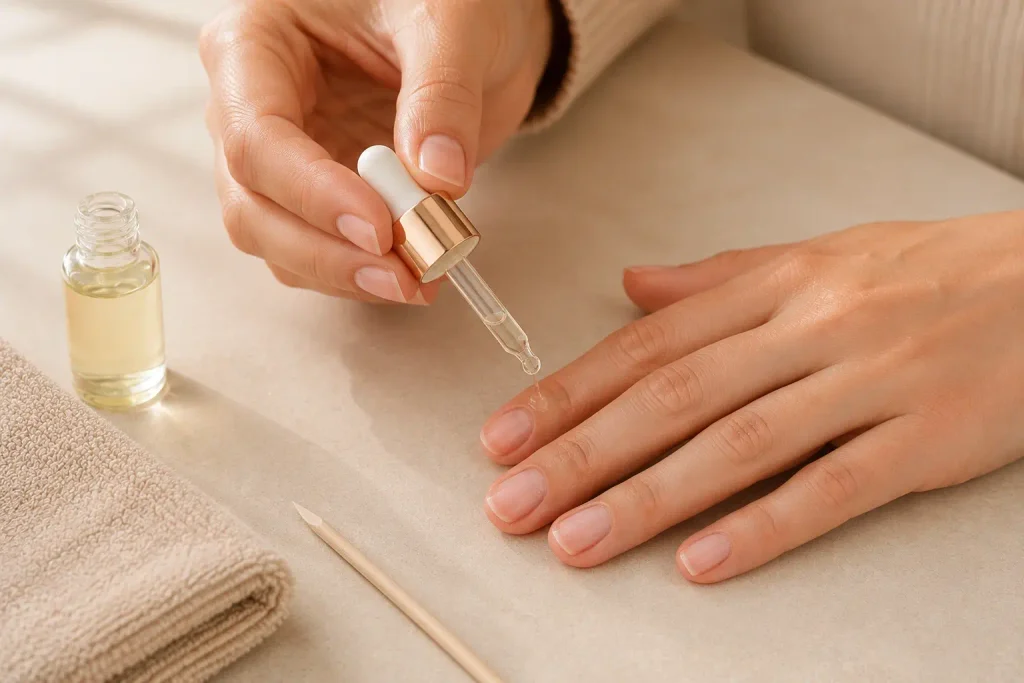
Your removal routine shouldn’t end the second the artificial nails come off.
Give your natural nails a little care afterward.
1. Wash your hands
Remove any remaining oil, adhesive, or acetone residue.
2. Apply cuticle oil
Massage cuticle oil around your nails and cuticles. I use Cuccio Naturale Cuticle Oil here too – it doubles as both a removal aid and aftercare product.
3. Moisturize your hands
Acetone and repeated soaking can leave surrounding skin feeling dry.
4. Give your nails a break if they feel weak
There’s no universal requirement that you must wait a specific number of hours or days before applying another set.
If your nails look and feel healthy, you can follow your normal routine.
But if they’re thin, peeling, sore, or irritated, give them time to recover instead of immediately applying another set.
Can I Reuse Press-On Nails After Removing Them?
Yes, sometimes.
Your ability to reuse a set depends on:
- how carefully you removed them
- whether the artificial nails became bent
- how much adhesive remains
- whether the design or finish was damaged
- whether acetone affected the material
Adhesive-tab sets are generally easier to reuse because the nails can often be removed without exposing them to acetone.
Glue-applied sets may require more cleanup.
Press-On Nail Removal Toolkit
If you wear press-ons regularly, these basic tools are worth keeping together:
| Tool | Why You Need It |
|---|---|
| Wooden cuticle sticks | Helps gently work around softened edges |
| Cuticle oil | Helps condition surrounding skin and cuticles |
| 100% acetone | Useful for stubborn nail glue |
| Cotton pads/balls | For acetone removal |
| Aluminum foil | Holds acetone-soaked cotton against nails |
| Fine nail buffer | Removes small amounts of remaining adhesive |
| Hand moisturizer | Helps restore moisture after removal |
Frequently Asked Questions
How do you remove press-on nails?
Soften the adhesive first with warm soapy water or acetone, depending on the adhesive you’re dealing with. Once the press-on begins to loosen, gently work it off without pulling or prying.
How do you remove press-on nails without damaging your natural nails?
Never rip or peel them off. Soak or soften the adhesive first, gently release the press-on, and avoid aggressive scraping or filing of the natural nail.
How do you remove press-on nails without acetone?
Try soaking your fingertips in comfortably warm, soapy water with a little cuticle oil for 10–15 minutes. Gently test the edges and repeat the soak if necessary.
How do you remove press-on nails with acetone?
Place acetone-soaked cotton over the nails and wrap with foil for about 10–15 minutes. Check whether the adhesive has softened and repeat if necessary rather than forcing the nails off.
Will oil remove nail glue?
Oil can help loosen the edges and make removal gentler, but it generally won’t dissolve strongly cured nail glue by itself.
Can Vaseline remove nail glue?
Vaseline can help protect and moisturize the skin around your nails, but it isn’t a reliable solvent for cured nail glue.
Can hot water take off fake nails?
Warm water may help loosen some adhesive, but extremely hot water isn’t necessary and can burn or irritate your skin.
What removes dried-up nail glue?
Acetone is commonly used to soften cyanoacrylate-based nail glue. Small amounts of residue can also sometimes be gently buffed away, but avoid excessive filing of the natural nail.
Can I take off press-on nails after one day?
Yes. Use the same gentle removal principle: soften the adhesive first and never pull a firmly attached nail away from the natural nail.
What is the fastest way to remove press-on nails?
For stubborn glue, acetone is generally faster at softening many cyanoacrylate-based adhesives than a warm-water soak. However, speed shouldn’t come at the expense of forcing the nail off.
Can I remove press-on nails with glue and reuse them?
Often, yes. If you want to reuse the artificial nails, use a gentle removal method and avoid acetone when the material or finish may be affected by it.
Final Thoughts
Taking off press-on nails shouldn’t hurt.
If you’re pulling, prying, or scraping hard, the adhesive hasn’t released enough yet.
The safest removal routine is really about patience: soften the adhesive, test the edges, and let the artificial nail come away gradually.
Once they’re off, clean your nails gently, apply cuticle oil, and pay attention to how your natural nails feel before applying another set.
And if your press-ons have been falling off long before you’re ready to remove them, that’s a different problem. In that case, check out our guide to why your press-on nails won’t stay on to fix the application and make your next set last longer.